
We're in a Content Generation Trap
Why a focus on sustainability—not more 'content'— is what the independent movement actually needs, and why 'A24 x Google' put it into focus

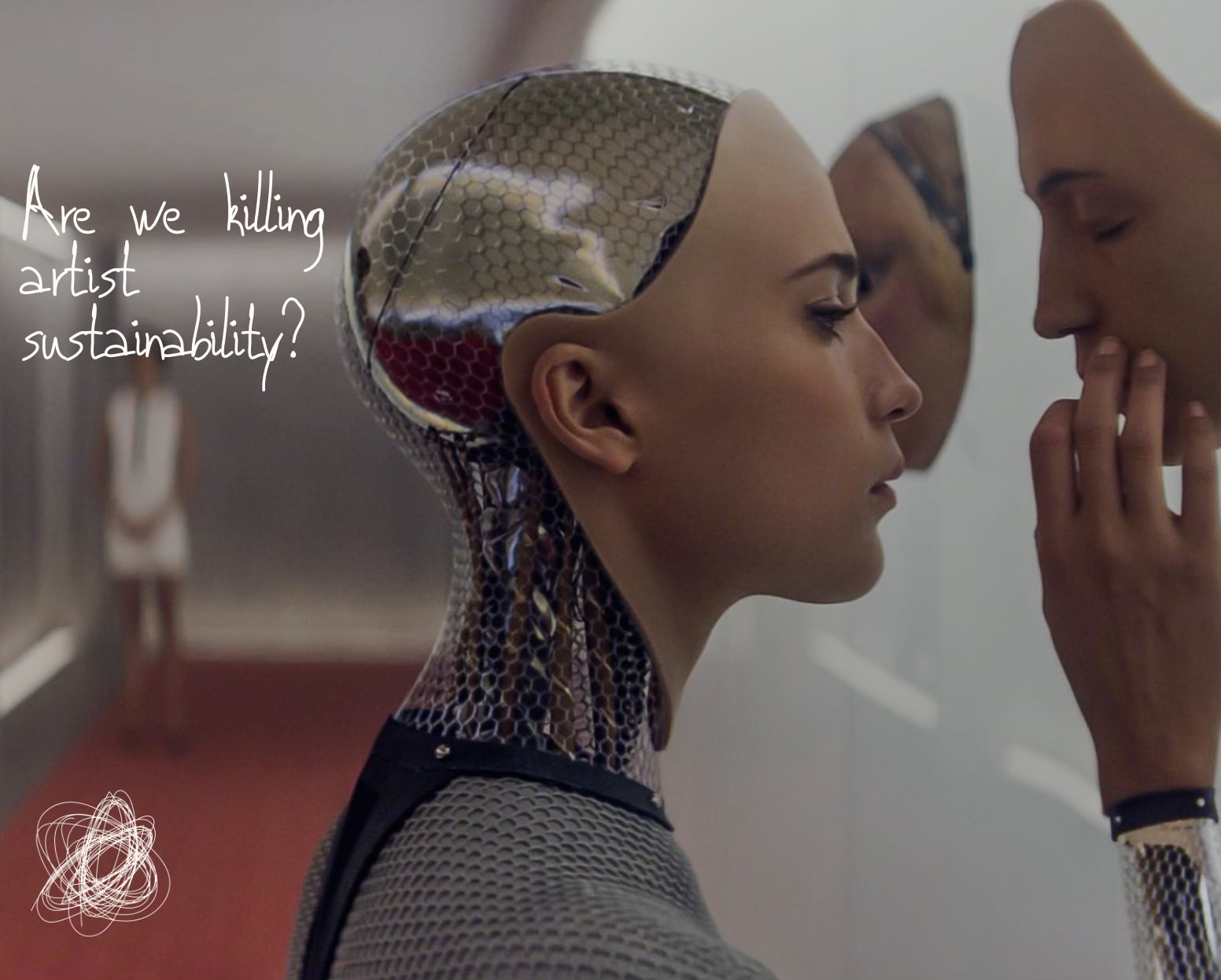
We spent last week at Cannes Lions, speaking with brand executives, agencies, and creators across the industry. And one thing came through louder than anything else, conversation after conversation: confusion.
Not the hype-cycle noise about AI, but something closer to genuine anxiety and real fear about survival.
That tension showed up in an unexpected place that same week: the music industry, of all places, put words to it before film did.
Surprisingly, we heard from veterans in the music industry first. Some of the sharpest perspective came from music-industry veterans — including Kenneth "Babyface" Edmonds, the 13-time Grammy-winning songwriter/producer and co-founder of LaFace Records, known for collaborating with artists including Justin Bieber, Madonna, OutKast, Jon B. and SZA. He put it best in a Wall Street Journal interview at Cannes. Their concern isn't AI itself — it's the flood of hundreds of thousands of AI-generated songs being poorly written, produced, and released every day, drowning out the sustainability of any single artist's career, not just their visibility. “Every aspect of the creative process needs to be human. All the imperfections and human experiences are what reach people and can’t be replicated.”
Then the week's hardest reality check came from Hershal Pandya's feature in Vulture, 'The Unglamorous Financial Realities of 5 Indie Filmmakers.' The piece lays bare how dramatically more fragile the film financing model has become, revealing the structural pressures filmmakers are under just to get a project made — let alone sustain a career. The article opens with:
Brady Corbet’s now-famous admission that he earned “zero dollars” from The Brutalist despite its awards run and the disconnect between prestige and personal financial return at the highest critical level of indie cinema.
Sophy Romvari , the emerging filmmaker behind Blue Heron, represents the next generation of independent filmmakers. Despite critical recognition and a growing international profile, she still works a day job in a movie theater while making films.
Dustin Guy Defa is one of the defining voices of the American "micro-indie" “working director” model. With a sustained career, respected body of work, has a constant reliance on fragmented financing structures, and shifting distribution economics.
Daniel “Danny” Lombroso (documentary filmmaker) If you expect documentaries to function primarily as commodities, you'll likely be disappointed financially.
Joel Potrykus (Buzzard, Relaxer) The veteran micro-budget director who speaks candidly about privilege, family money, and the realities of surviving outside Hollywood and what’s required to keep making films.
This isn't about AI in a vacuum. It's about what happens when a precocious technology — barely three years into mass availability, yet startlingly capable — meets a fragile economy in a more precarious state. And why the A24 × Google deal sharpens puts precarity-meets-precocity under a microscope.
Reducing the pressure
Pandya exposes yet another brutally honest portrait of an industry in slow collapse. It lands squarely in this moment. It’s less an exposé than a synthesis of what filmmakers have been living through but what is rarely said out loud critical success no longer guarantees economic stability and that great films are no longer enough. You need a system behind them.
The shift has introduced a different kind of pressure where filmmakers are expected to carry more of the development burden, audience signaling earlier, packaging, financing more precisely, and proving viability upfront.
Callo is reframing it as what’s changed isn’t creativity. It’s the infrastructure around it that includes:
audiences before production
recurring revenue outside a single film release
reduce dependence on shrinking acquisition markets
develop long-term careers rather than one-off projects
proving viability
This is where an intelligence layer enters the moment not as a replacement for creativity, but as another accelerator, absent of an ecosystem that moves to development, packaging, protections, authorship, execution, and compensation in tandem.
We call it Callo.
Everyone is asking why is A24 working with AI? We’re asking, why A24?
WIRED describes this week’s backlash from fans who believe the latest partnership of A24 and Google risks giving AI cinematic cultural legitimacy.
It’s become emotional to say the least as one of the most polarizing stories in Hollywood this past week because it collides with two identities that many people thought were incompatible. The strongest voices include independent filmmakers, and writers’ rooms that are still sour post-2023 strikes, plus “X”, and Reddit creator communities.
Our question is why begin with the industry’s most influential tastemaker instead of the infrastructure that filmmakers rely on every day?
Why A24?
Why didn’t Google DeepMind partner with other parts of the value chain that lower production costs across the industry without carrying the symbolic weight of aligning with independent cinema’s most influential cultural brand and the funding that would have been useful in driving a broad swath of companies forward in supporting the indie filmmaker ecosystem?
Perhaps if independent filmmaking was financially healthy with robust financing, meaningful backend participation, and sustainable career paths, AI would likely be viewed more like any other production technology but the partnership has arrived at precisely the moment when filmmakers are asking “How do I survive making films?” The partnership blow:
A24, the studio synonymous with filmmaker-first, auteur-driven independent cinema.
Google DeepMind, one of the world’s leading AI research organizations.
Stated objective
AI is not to “generate A24 movies with AI, but to embed DeepMind researchers alongside filmmakers to develop production tools and creative workflows shaped by artists" said A24.
Google emphasized that A24 filmmakers would help guide the development of future AI tools rather than having them imposed afterward. Maybe A24 is trying to influence AI instead of being disrupted or so they say is their argument.
Scott Belsky, who leads A24 Labs (and is the former Chief Product Officer at Adobe and founder of Behance), has emphasized that the goal is to preserve creative control, with the underlying view that AI is coming regardless. A24’s argument is that digital cameras were once controversial, so were nonlinear editing and CGI—each ultimately becoming another production layer in filmmaking.
But this feels fundamentally different from A24 adopting a new tool like a camera or editing system, when it’s trained on creative work, license, and permission. And that’s where the skepticism emerges not just about the technology itself, but about what it says to the community about how valuable their work is.
In fact when we talked to individuals at Google on the AI team, we were told big splashy deals like this is all in order to make AI feel inevitable not only to the creators, but to consumers.
The symbiotic bat-signals heard a round the world
The messaging from both companies was intended to be remarkably careful.
For over a decade A24 has become the representation for a cultural symbol to independent filmmakers, but also consumers. It represents human taste, taking risks, protecting creatives and thoughtful entertainment over algorithms. But you can’t escape the word choice used in the release:
research partnership
filmmaker-guided
workflows
creative control
not replacing artists
A24 is conscious of the industry challenges that have dominated conversations since the Hollywood 2023 strikes and are being careful in the introductory language of their new endeavor.
A24 as the brand doesn’t just finance movies, it acts as a cultural gatekeeper. The symbiotic relationship between A24 embraces as a filmmaker, actor, or aesthetic is sending a global bat signal to the industry that this is the future of cinema and this is the way it is.
On the other hand workflow determines what gets made. Earning potential determines who can afford to keep making it. Fanbase determines what survives contact with the audience. A24's entire competitive advantage has evolved to all three being human-calibrated taste in the room, patient studio, loyalty earned by visible audience. The Google deal now touches all three simultaneously.
Workflow tools don’t require a research lab like DeepMind to help improve a workflow.
Through the partnership it gives DeepMind proximity to taste learning from the leading tastemaker in the business—creating conditions for patterns. A research partnership embedding DeepMind in A24's workflow process is structurally, the apparatus you'd build if you wanted to learn what predicts outcomes. Intent aside on either side, that's just what the architecture points toward.
Four jobs to make a film.
Meanwhile, Hershal Pandya’s Vulture feature isn’t really about money. It’s about trust.
The five filmmakers he profiles expose an uncomfortable reality: festival acclaim, critical praise, and even awards recognition no longer guarantee a sustainable career. Independent filmmakers are teaching, freelancing, making commercials, and piecing together multiple jobs just to finance the next project. The creative pipeline hasn’t broken. The business model has.
That’s why the reaction to A24’s partnership with Google DeepMind has been so emotional.
For many filmmakers, the question isn’t whether AI belongs in filmmaking. It already does. The question is who gets to shape it and who really benefits from it.
As producer and entrepreneur Grant Lee has argued, AI shouldn’t simply automate creativity; it should help creators build sustainable businesses around their work. We believe this deeply at Callo, that distinction matters. Independent filmmakers don’t need another tool that promises to generate content faster. They need tools that make the business of creating more equitable.
We’re already seeing what that looks like in adjacent creative industries. Music platforms like DistroKid removed friction from distribution, automated royalty splits, simplified rights management, and helped artists keep more of what they earn. They didn’t replace musicians. They made it easier to be one.
Film needs the same kind of infrastructure.
Imagine intelligence that helps pressure-test a script, organize investor materials, package a project, coordinate collaborators, simplify rights agreements, manage deliverables, analyze audience positioning, or challenges a weak third act with thoughtful notes instead of rewriting it for you. Not a replacement for taste, but a collaborator that helps sharpen it. Not a substitute for instinct, but a way to develop it. That’s everything we focus on with Callo:
As Kenneth “Babyface” Edmonds captured when he recently said, AI shouldn’t chase the soul of the work. It should protect the time, focus, and resources that allow artists to create it.
Technology earns trust when it expands opportunity, not just efficiency.
Independent Operating System built by Callo
Talent isn’t the bottleneck anymore and for many filmmakers, that’s the shift that matters most, AI stopped being a productivity story and became a labor story—less about speed, more about who gets value, credit, control, and laid off.
What’s missing isn’t creativity. It’s intel. Callo, by contrast, is infrastructure for the independent. It exists to give the people without a studio’s resources access to signals they’d otherwise never see. Same underlying capability, opposite distribution of power. One concentrates predictive advantage inside a single gatekeeper; the other distributes it to the outsiders.The ability to say: this works, this doesn’t, this is where you cut. A system that helps you control and shape ideas early enough that they can actually be financed, not just imagined. The ability to actually care.
That’s the role emerging infrastructure has to play—something closer to a creative concierge than a tool for generation. Not replacing taste, but reinforcing it. Helping creatives and producers see what a standout looks like 18 months ahead of the market, not just what’s trending today.
In that model, feedback becomes leverage. Notes become structure. Development becomes continuous, not episodic. And the gap between creative intent and economic viability starts to close.
Because ultimately, this debate isn’t just about AI capability. It’s about trust—whether filmmakers believe the systems being built around them are designed to strengthen creative control, or quietly optimize away the conditions that make independent filmmaking possible in the first place.
That’s why the reaction feels so charged. A24 isn’t just another studio in this context it’s a cultural signal. And when cultural signals align with frontier technology, the questions becomes accessibility, opportunity and who is this really for.
Are you developing, packaging, or taking your projects to market? The platform independent producers, writers, and directors are using right now to run their slates is Callo. → apply at www.wearecallo.com or set up a demo calendly.com/callo